Two Ways to Share an Account
Maya asks to use your Netflix at 11:02 PM. Text her the password and you end up signed out of your own account. Send a Multifactor link and she’s in without ever seeing it.
3 min read
On this page
At 11:02 PM a text comes in from Maya: “can I use your Netflix?” Most of us have had that message, and most of us answer it the same way, by sending the password.
I drew that minute twice to see where each answer leads. The two phones below start out identical. On the left I text Maya the password, and on the right I send her a Multifactor link.
The same 11:02 PM, two ways
Maya asks to use your Netflix. On the left you text her the password. On the right you send her a Multifactor link.
Without Multifactor
Tonight 11:02 PM
11:09 PMShe’s in, and it’s her password now.
- 1Password in a textIt stays in both phones.
- 2Codes relayed by handThe first one expired.
- 3Signed out of your own accountShe did what the site asked.
- 4Now it’s her passwordYou need it back to sign in.
With Multifactor
Tonight 11:02 PM
Account
11:02 PMShe’s in, and it’s still your password.
- 1One link, no passwordNothing to copy out of the chat.
- 2Signed in as youNo sign-up needed.
- 3Password stays hiddenShe never sees it.
- 4Settings stay yoursNo password changes or sign-outs.
The usual way
The password now sits in two message threads on two phones, for as long as either of us keeps them. That part happens the moment I hit send, and it's the part nobody thinks about again.
Then Netflix sees a device it doesn't know and sends a code to my phone, so I read it out to Maya. The first one has expired by the time she types it, and I send another. Once she's in, the site offers to sign out other devices, and she says yes, which signs me out too. Then she changes the password so she won't forget it.
Nobody did anything wrong. At every step Maya did what the screen in front of her asked. Seven minutes later she's watching, and it's her password now.
With a link
On the right I send a link. I connected the account to Multifactor once, earlier, by signing in with its password. Tonight I create a link for Maya and send it, with its pass in a separate message.
Maya opens the link, enters the pass, and lands on the account already signed in as me. She doesn't need a Multifactor account. The page comes from a secure browser in the cloud that Multifactor keeps signed in, so my password never reaches her browser.
The link also decides what she can do there. On Hacker News, no link can change the password or sign anyone out, not even one with full access, so the two steps that locked me out on the left can't happen on the right. If she tries one, it's refused before it reaches the site, and I can see the attempt in History along with everything else she did. When she no longer needs access, I revoke the link and her tab tells her the access was removed. There's no password to change afterwards.
It's still 11:02. Maya's in, and it's still my password.
Why two phones
I first drew this comparison for our landing page. The rule I kept to was that nothing differs between the phones except the answer: the same minute, the same request, the same hardware and the same thread layout. Anything else that changed would have been a second variable, and the picture only works if one reply at 11:02 decides how the rest of the night goes.
The numbered notes sit outside the phones so the threads still read like real conversations. The night on the left is made up from the ways a shared password usually goes wrong, so treat it as a composite rather than a transcript.
Try it
Netflix isn't one of the sites Multifactor Lite supports yet. Today it works with Hacker News, and our goal this month is to go from one site to dozens. Sign up at lite.multifactor.com, connect your Hacker News account, and send a link to a friend. It takes about two minutes.
We're redefining zero-trust — so you can protect your accounts with confidence.
Identity is your first and last line of defense, and the root cause of most application security breaches. Multifactor's provably secure zero-trust solutions cryptographically guarantee that only authorized users can access sensitive data, turning identity into your greatest asset in the fight against cyber threats. Learn more about our research, or reach out to explore working together.
Related Posts
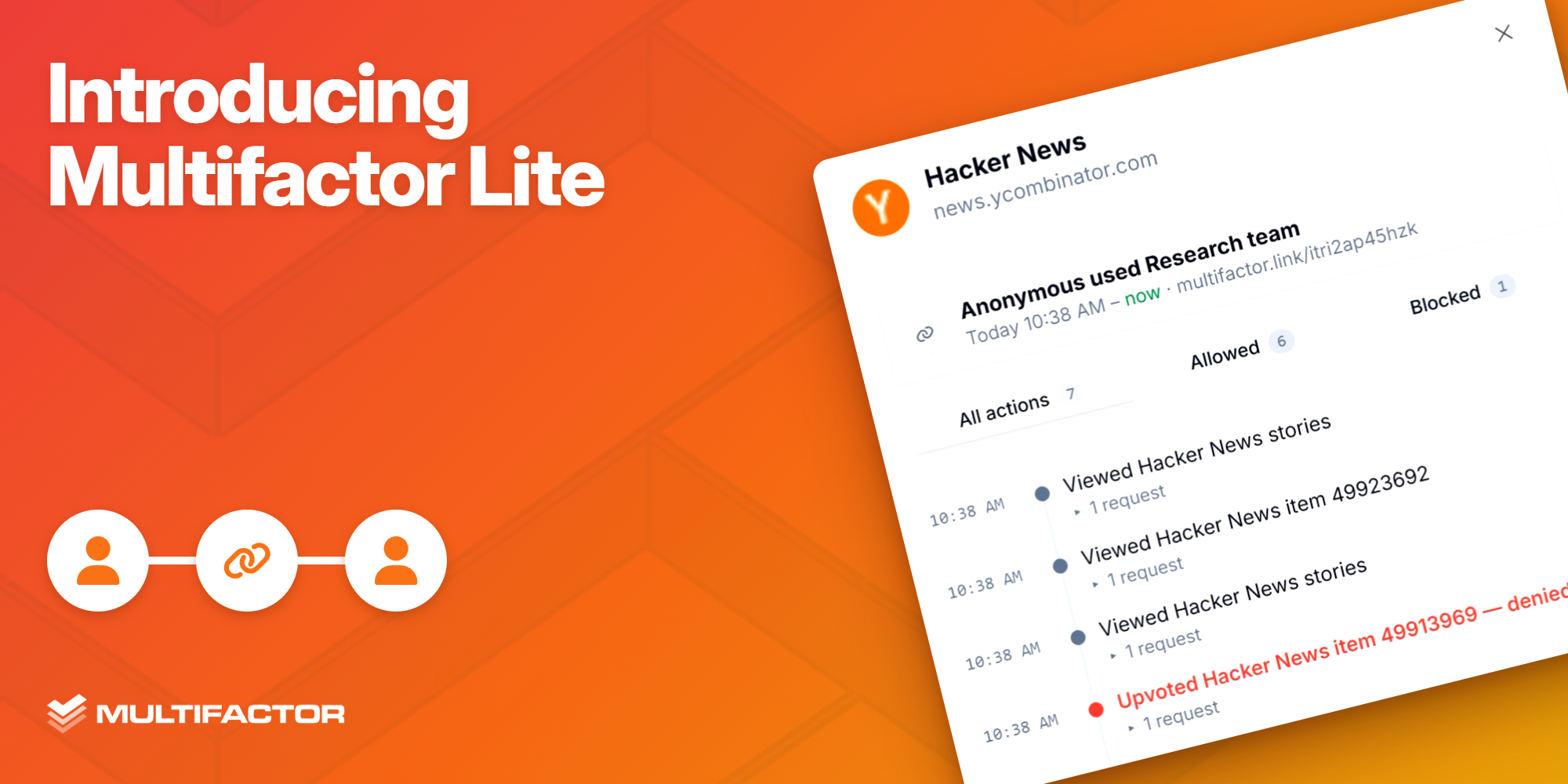
Introducing Multifactor Lite: Share Online Accounts by Sending a Link
2026-10-01
In our second Lock-In Week we cut Multifactor down to the one thing we care about most: sharing an online account by sending a link, with permissions you choose, a live log of every action, and instant revocation. Try it today.
How to Share an Account With Your Agent and Know What It Did
2026-09-15
Checkpoint gives your agent scoped access to any online account, enforced at the network layer inside a trusted execution environment, with a verifiable log of every action it took.
I'm a Designer. Last Week I Shipped Dark Mode to Production.
2026-07-27
How AI tooling closed the gap between design and code at Multifactor — and what it means to be a design engineer now.